
Name the natural
Identify the reflexive move: avoiding conflict, over-solving, defending certainty, or mistaking activity for progress.
The instinct, the politics, the path of least resistance, the way it's always been done — leadership is the discipline of overcoming all of it.
Under pressure, people return to what feels familiar. They defend. Delay. Rescue. Avoid conflict. Protect status. Call instinct wisdom because it arrives quickly.
The doctrine exists to interrupt that reflex. It gives leaders a language for naming the pattern before the pattern becomes the system.
Leadership is not the absence of instinct. It is the discipline of seeing the instinct clearly enough to choose something better.
The 52 Maxims form the philosophical spine of CATALIIST. They are embedded into coaching, assessment interpretation, CATALIIST360 report language, and the development actions that follow.
Identify the reflexive move: avoiding conflict, over-solving, defending certainty, or mistaking activity for progress.
Connect the maxim to observable behavior, rater feedback, psychometrics, team dynamics, and operating constraints.
Turn insight into a specific behavior, rhythm, conversation, or decision rule that can be practiced and reviewed.
The full 52 remain the operating doctrine. These samples show how the framework behaves: each maxim names a pattern, then points toward a better practice.
Blind spots rarely announce themselves. They arrive as certainty.
Feedback becomes evidence when leaders stop treating self-perception as the whole record.
The need to win the argument can conceal the better answer.
We use this maxim to challenge defensiveness, premature closure, and executive overconfidence.
Experience creates shortcuts. Shortcuts become invisible constraints.
This is where assumption-testing enters the work: what must be true for this story to hold?
Culture does not survive where trust is treated as optional.
The maxim turns “relationship issues” into observable conditions that can be repaired or enforced.
Avoided conflict does not disappear. It becomes system debt.
This is the diagnostic line between keeping peace and protecting performance.
Rescue feels useful. It often prevents development.
The maxim reveals when leaders are creating dependency while believing they are helping.
Experience repeats until reflection changes the pattern.
This is where insight becomes practice: review the moment, name the natural move, choose the next one.
CATALIIST uses the doctrine to move faster from abstract feedback to usable development work. The maxim names the behavior. The assessment shows the evidence. The coach turns it into practice.
360 feedback, behavioral data, interviews, and operating context.
The leadership pattern is named in plain language.
A seasoned professional interprets the signal and challenges the easy story.
The leader leaves with a specific practice, not a motivational phrase.
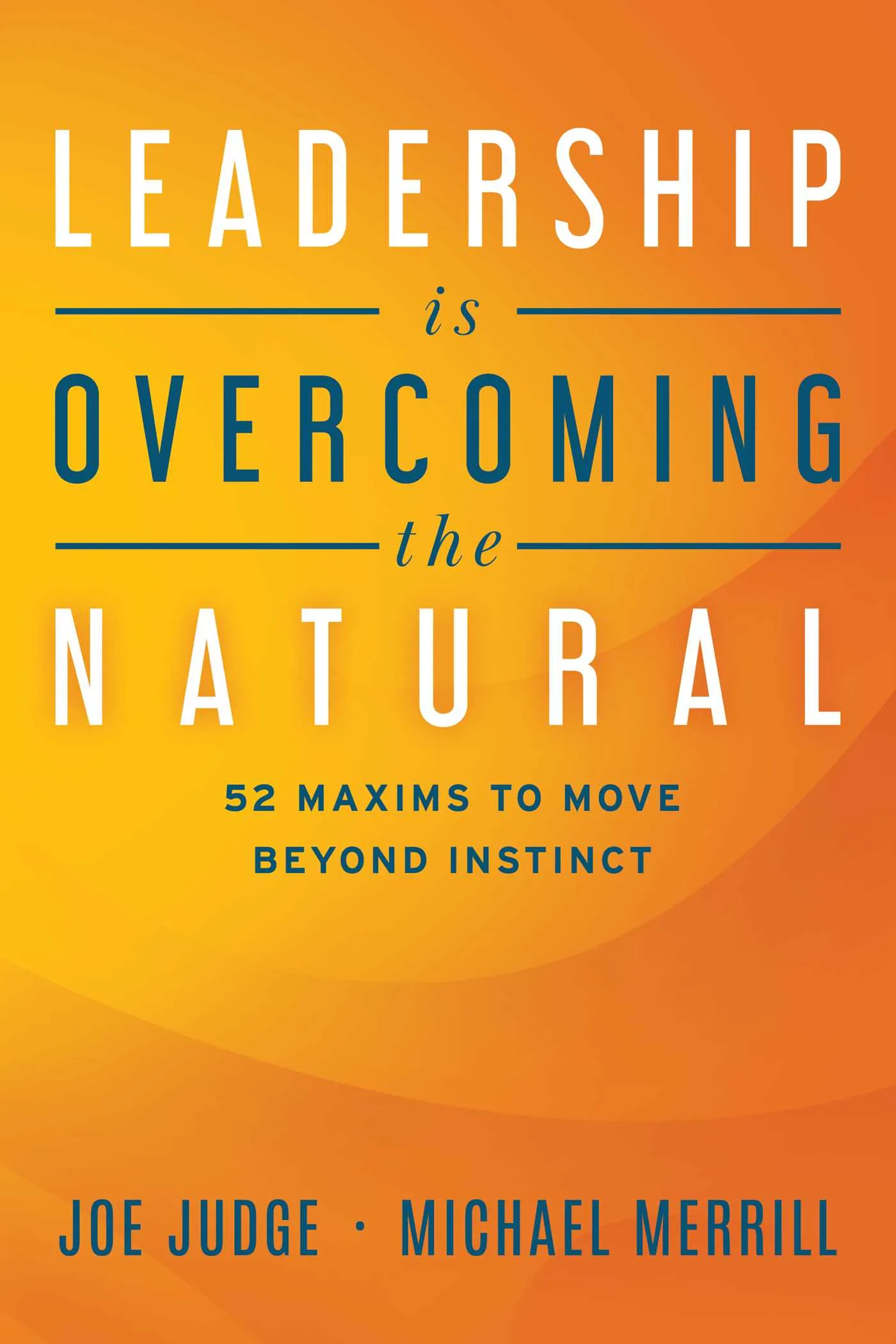
Leadership Is Overcoming the Natural, co-authored by Joe Judge and Michael Merrill, is the source of the 52 Maxims. It is the doctrine behind the LII in CATALIIST.
Start with a brief diagnostic. If the signal points to a leadership constraint, we can determine whether CATALIIST360, coaching, or broader system work is the right next move.